Invited Talks
Ergotropy and quantum heat engines
Prof. Ramandeep Singh Johal
IISER Mohali
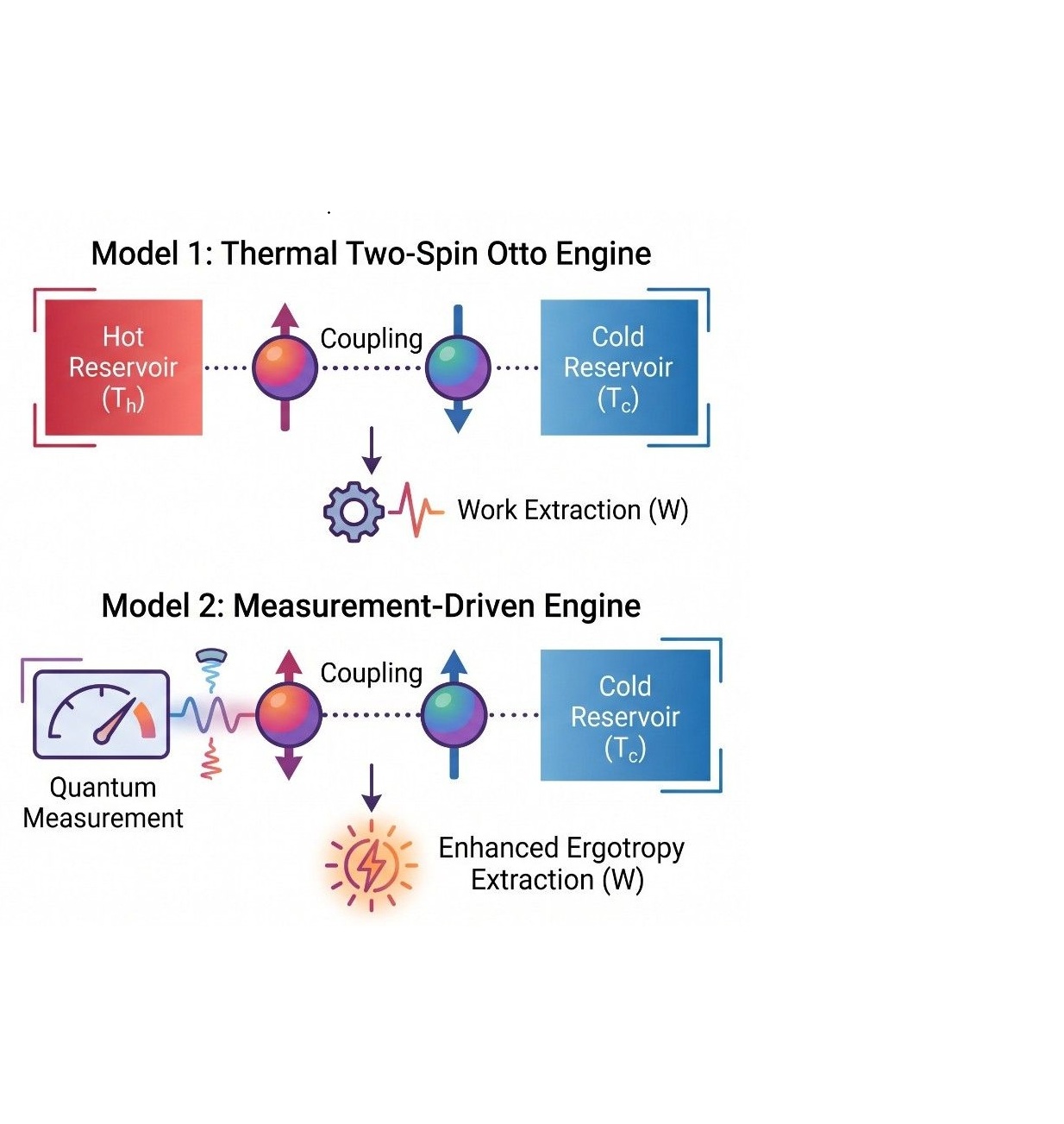
Ergotropy is defined as the maximum work extractable from a quantum system via a unitary process using a cyclic evolution of its Hamiltonian. Such an initial state is known as an active state. In contrast to classical thermodynamics, the system does not end in a thermal state, but in a passive state from which no further work can be extracted. We explore the extraction of ergotropy via different models of quantum heat engines.The first model is of two spins at different initial temperatures, and is analogous to an Otto engine with two heat reservoirs. In the second model, we replace one of the reservoirs with a quantum measurement device. Our working medium consists of two coupled spins and we consider generalized measurement schemes. The post measurement state can be an active state. We introduce an ergotropy extraction step in the four stage cycle and analyze the enhancement in the performance of
the engine.
Singular Optics meets Machine Learning: High dimensional Structured Light demultiplexing in classical & quantum domain
Dr. Vijay Kumar
NIT Warangal
Structured light beams, particularly those carrying orbital angular momentum (OAM), offer a powerful platform for high-dimensional optical communication. Yet, traditional demultiplexing methods often reliant on interference or diffraction struggle with alignment sensitivity, limited scalability, and inefficacy in handling intensity-degenerate modes. This presentation introduces a machine learning driven approach to structured light demultiplexing based on speckle pattern recognition. By harnessing the random scattering of light through diffusers and analysing the resulting speckle patterns with convolutional neural networks, we achieve robust, single-shot classification of OAM modes. This framework operates efficiently across detector types: 2D cameras, 1D line arrays, and even 0D single-pixel detectors, enabling compact, low-cost, and scalable implementations. We further demonstrate spatial-to-temporal mapping techniques, converting complex spatial modal information into temporal signals for high-speed processing with reduced data overhead. Crucially, the approach extends seamlessly into the quantum domain, allowing for the classification of entangled OAM photon pairs. The result is a versatile, alignment-tolerant, and reference-free demultiplexing architecture that works from classical to quantum domain. It enables high-throughput, non-line-of-sight, and fiber-compatible optical systems with minimal computational demand advancing the frontiers of singular optics and intelligent photonic signal processing.

Deterministic Quantum Dot Light Sources for Scalable Photonic Quantum Technologies
Dr. Priyabrata Mudi
Technical University of Berlin
Semiconductor quantum dots (QDs) are leading solid-state emitters for integrated quantum photonics, capable of generating on-demand, high-purity single photons as well as entangled photon paurs. However, practical deployment is limited by low extraction efficiency, charge noise, fine structure splitting and fabrication scalability. This talk highlights recent advances in overcoming these bottlenecks using deterministic integration of QDs with electrically contacted circular Bragg grating (CBG) nanostructures to yield bright, electrically tunable quantum light sources with suppressed charge noise. Additionally, this talk will focus on telecom-band QDs compatible with silicon photonics operating at liquid-nitrogen temperatures, alongside marker-free deterministic workflows for scalable, site-controlled device fabrication. These developments provide a practical roadmap toward chip-integrated quantum light sources for long-distance quantum communication.
Seeing hidden Currents and exploring their behavior in Quantum Materials
Prof. Satyajit Banerjee
IIT Kanpur
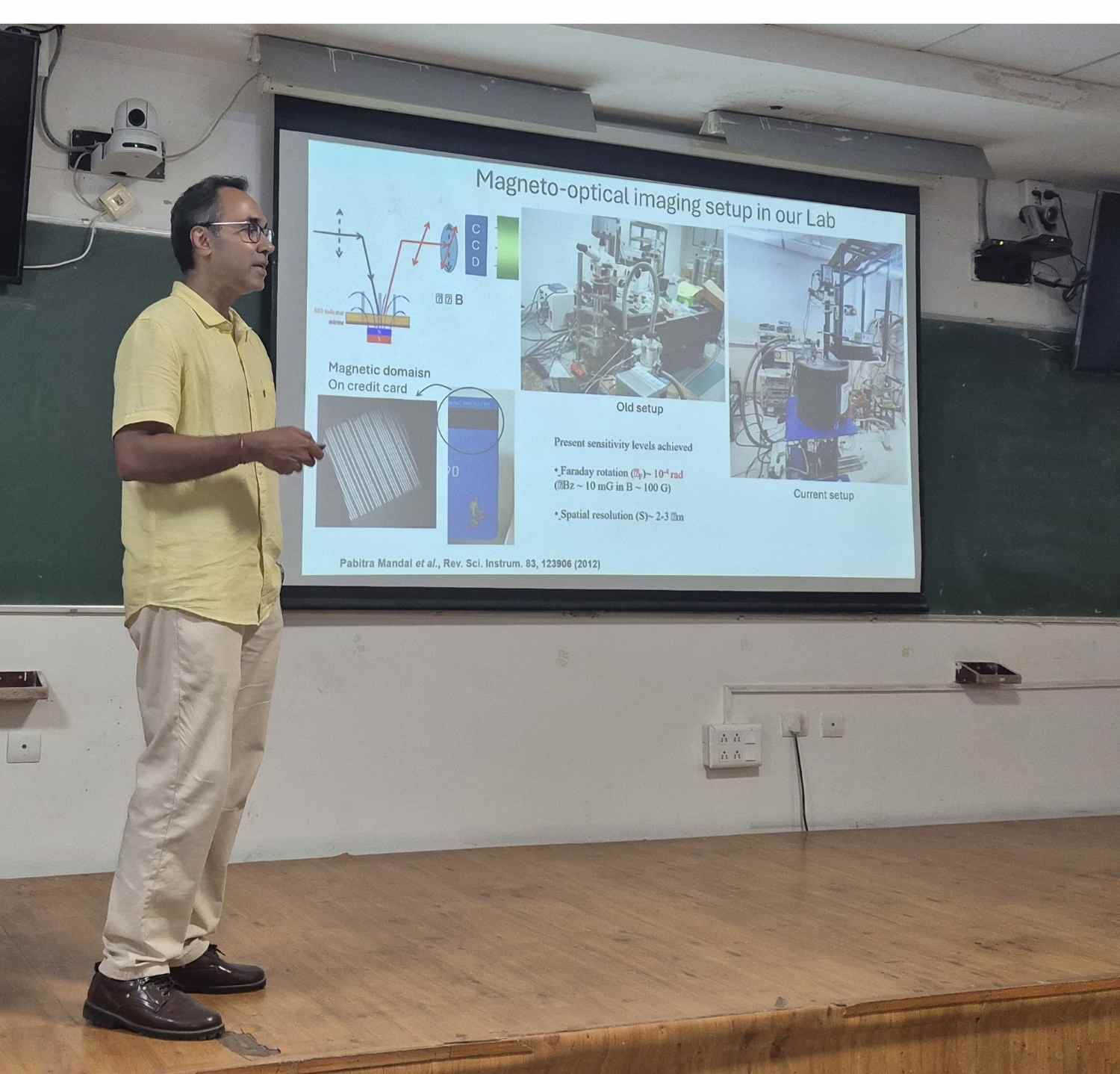
Electrical current is one of the most fundamental observables in condensed matter physics, yet directly visualising how it flows through quantum materials remains remarkably challenging. In many modern quantum systems—including topological insulators, correlated electron materials and superconductors—the current distribution contains valuable information about the underlying electronic states, often inaccessible through conventional electrical transport measurements alone. In this seminar, I will describe our efforts in my lab at IIT Kanpur to develop non-contact electrodynamic techniques capable of imaging and probing current flow with high sensitivity. Using magneto-optical imaging and inductive measurements, we directly visualise current distributions and investigate how charge transport evolves in a variety of quantum materials.
I will first discuss current imaging in topological insulators, where we directly observe the competition between surface and bulk conduction. I will then present our recent work on the topological Kondo insulator SmB₆, where non-contact electrodynamic measurements reveal evidence for a correlated low-temperature surface state that exhibits two-fluid-like behaviour beyond the conventional topological insulator picture. Time permitting, I will briefly illustrate how these experimental approaches are being extended to superconductors and other strongly correlated quantum materials, highlighting opportunities for developing new electrodynamic probes of quantum matter.
Creating a Second-Order Nonlinearity by Breaking Symmetry: The Hunt for χ(2) in Silicon Photonics
Prof. Joerg Schilling
University Halle-Wittenberg, Germany
Second-order nonlinear optical processes such as frequency conversion, optical parametric amplification, and entangled photon-pair generation play a central role in modern photonics and quantum technologies. However, widely used materials in silicon photonics, including Si, SiO₂, and Si₃N₄, are centrosymmetric and therefore lack an intrinsic second-order susceptibility (χ(2)). In this talk, Prof. Schilling will discuss approaches to engineer an effective χ(2) in silicon-based materials through symmetry breaking and electric-field-induced nonlinearities. The seminar will highlight recent advances demonstrating large effective nonlinearities in silicon-rich nitride and oxide platforms, opening new opportunities for active nonlinear processes, integrated photonics, and future quantum technologies

Superconducting and Semiconducting Technologies for Advanced Computing Applications
Dr. Manoj Kumar
Technical University of Munich
As we are entering into the data-intensive computing era, classical systems i.e., implemented with conventional CMOS technology are becoming energy in-efficient. Thus, neuromorphic and quantum computing are intriguing technologies for efficient complex computational tasks. However, quantum processors e.g., implemented with superconducting (SC) qubits, are limited by the lifetime and coherence time of the qubits due to inherent microwave losses at different interfaces of the qubits and read-out resonators. More Specifically, these losses are majorly contributed by native-oxide growth at metal-air, metal-substrate and substrate-air interfaces. These losses lead to limit the internal quality factor of the resonators i.e., key component of the SC qubits. We are working on the optimizations of these interfaces and surfaces towards the prevention of native-oxide growth. In first part of this research talk, we will be discussing about the encapsulation and passivation of the metal-air or substrate-air interfaces with different process and material technologies helping to prevent the oxidation growth to reduce the losses thus resulting in the improved quality factor of the resonators. Brain-inspired neuromorphic computing i.e., leveraged by human brain-principles is projected to perform computationally hard problems with significant energy and time savings. Semiconductor Non-Volatile Memory (NVM) technologies (i.e., Resistive Random Access Memory (RRAM), Optoelectronic-RRAM, Phase-change memory (PCM)), are becoming interesting alternatives due to in-situ data storing (i.e., encoded in terms of their physical resistances) and computing at the same physical location thus overcoming the challenges of von-Neumann architecture. As a second part of this seminar, we will be discussing these NVM technologies and their demonstrated applications for neuromorphic computing, retinomorphic sensing etc.
Energy-efficient Memristive Devices for Analog and Neuromorphic Computation
Dr. Sanjay
University of Edinburgh
Neuromorphic computing with analog behavior is an emerging technology that has remarkable potential to mimic the physical structure and various functions of the human brain to create more efficient and adaptable artificial intelligence systems. Innovative memory devices such as memristors can help us to create an energy-efficient biologically-inspired system that offers numerous computational capabilities in neuromorphic computing, bringing us closer to replicating the human brain with better efficiency and adaptability. Neuromorphic computing offers a biologically plausible approach to fill the gap between human and artificial intelligence. In my research, I have developed wafer-scale highly stable oxides-based memristive crossbar arrays chps (MCAs) which are fully capable to emulate the various neuromorphic computing functionalities in terms of potentiation and depression processes, bipolar analog switching, writing of random alphabet in a selected crossbar array structure, multilevel current programming functionality, and spike time-dependent plasticity (STDP) as analogous to the Hebbian learning rules in the real biological human brain. Also, the developed wafer-scale MCAs exhibit excellent stability in device switching voltages in both device-to-device (D2D) and cycle-to-cycle (C2C) cases and show the least values of coefficient of variability, especially in the case of metal-oxide MCA. Therefore, the performed experimental study opens a new path to develop neuromorphic chips with better stability and efficiency.

Superfluid He-II Cavity Optomechanics for Sensing and Analogue Gravity applications
Dr. Sumit
IIT Dhanbad
Over the past decade, superconducting circuits have emerged as a versatile platform for coupling to various degrees of freedom, including qubits and mechanical resonators. This has led to a plethora of results with applications in quantum sensing and computing. In this talk, I will introduce a unique degree of freedom—the fourth sound modes in superfluid He-II, which effectively act as a mechanical resonator. I will present the full characterization of this system across different temperatures, along with results on its nonlinear dynamics and turbulence phenomena. Building on this, I will discuss our latest experiments on third sound modes/surface waves on a thin layer of superfluid He-II coupled to a microwave re-entrant cavity for analogue gravity studies. In this setup, the equations of motion naturally map onto an effective curved spacetime metric, providing a controlled platform to simulate cosmological phenomena.
Beyond the Gaussian: Generating and Detecting Custom-Shaped Light Beams
Dr. Varun Sharma
Cornell University
Spatially shaping of the coherent sources has been a key to various applications from microscopy, communication and quantum information processing. Generation of such a beam relies on phase mask and spatial light modulators, and nonlinear optics for broad wavelength coverage. In this talk I will be discussing methods of generating such beams over a broad range of wavelengths with high power and even at a single photon level. Additional discussion will be followed with new advancement in developing new detectors to measure and resolve such modes.
Neurons and the Schrodinger Equation
Prof. Partha Ghose